






As humanoid and quadruped robots move from research labs into real-world applications, safety standards must evolve just as quickly.
That work is happening within the International Organization for Standardization (ISO). Through Technical Committee 299, experts from around the world are developing new safety standards specifically for dynamically stable industrial mobile robots.
Unlike traditional industrial robots that remain fixed in place, humanoids and quadrupeds robots rely on continuous active control to maintain balance. This introduces a unique challenge: How do you design safety systems for machines that can lose stability?
A Structured, Consensus-Driven Process
ISO standards are not written by a single company or regulator. They are developed through global collaboration.
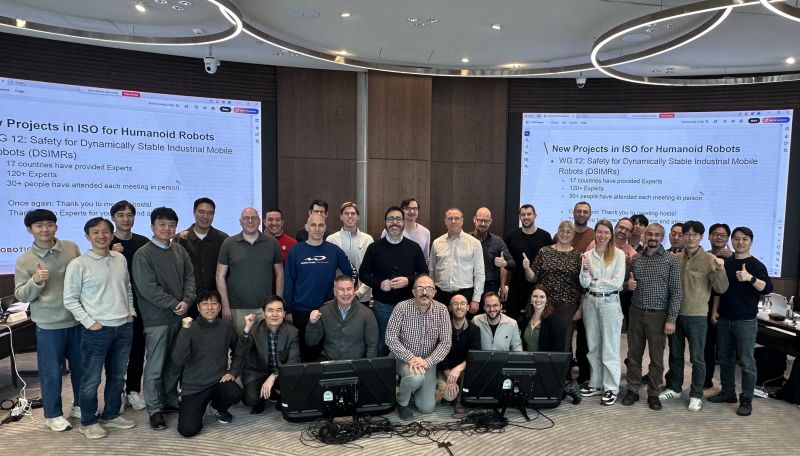
We are actively participating in Working Group 12, which focuses on safety for dynamically stable industrial mobile robots. These working group meetings typically span several days, bringing together manufacturers, safety engineers, and technical experts to debate draft language in detail. Smaller technical subgroups meet between sessions to refine proposals and resolve open questions.
The humanoid robotics safety standard began development in July 2025 and follows a three-year timeline. The process includes:
- Development of an initial draft
- Committee-level review and consensus
- Broader ISO-wide comment and voting
- Final approval and publication
Defining Safety Without Limiting Innovation
Because no prior standard exists for dynamically stable humanoid robots, the group is building foundational safety principles from the ground up.
One of the central challenges is avoiding overly prescriptive requirements. Standards must be clear enough to ensure safety, yet flexible enough to accommodate rapid advancements in AI-driven control systems.
The objective is to define safety outcomes while allowing manufacturers to determine the best technical path to achieve them.
Why Participation Matters
We are not simply observing these discussions. We are actively contributing to the safety discussion and participating in smaller writing subgroups that meet regularly to develop draft content.
Participation in ISO working groups provides early visibility into emerging market expectations and regulatory direction. It also creates opportunities to collaborate with industry peers and help shape standards that are both rigorous and practical.
As humanoid robotics continues to accelerate, safety must lead innovation. Global collaboration through ISO ensures that progress remains responsible, scalable, and trusted.
Standards development may not always be visible to the broader market, but it plays a critical role in enabling the next generation of safe, collaborative robotics.