






By Patrick Biehler, Simulation Engineer
Before a product is manufactured, engineers make thousands of decisions that affect performance, reliability, cost, and manufacturability.
What if we could identify better designs earlier in the process?
That question drives much of my work as a simulation engineer and became the foundation of my PhD research.
Simulation helps our engineering teams evaluate designs before physical prototypes are built. By understanding how products will behave under real-world conditions, engineers can make more informed decisions and accelerate development.
My research focuses on topology optimization, a simulation-driven approach that helps determine the most efficient design for a specific application.
In simple terms, it helps answer a fundamental engineering question: Where is material truly needed, and where can it be removed without sacrificing performance?
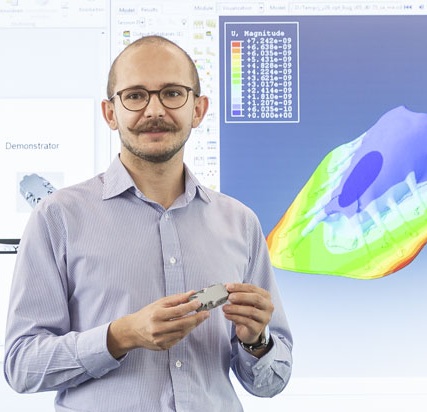
The result is often a lighter, more efficient design. However, there is an important challenge. The most efficient design generated by simulation is not always practical to manufacture.
That gap led me to develop an additive-manufacturing-driven topology optimization approach that helps engineers identify designs that are both high performing and manufacturable.
To support this work, I used CalculiX, an open-source simulation platform that enables advanced engineering analysis. Today, we also use CalculiX within our company for mechanical and thermal simulations, supporting engineers across multiple sites and product development activities.
The flexibility of an open-source platform allows us to automate workflows, develop custom tools, and adapt the software to our specific engineering needs. Over time, these capabilities have helped improve efficiency and provide greater access to simulation tools for engineering teams.
This November, I will present this work at the first CalculiX User Conference. While I will discuss the research itself, I am equally excited to share how the technology is being applied within our company and the opportunities it creates for future innovation.
The most meaningful innovations often happen when academic research and industry challenges come together. By connecting both worlds, we can create tools that help engineers make smarter decisions, develop better products, and move ideas from concept to reality more efficiently.
As I continue working toward completing my PhD, one lesson stands out: innovation is a continuous learning process. Every project, research challenge, and engineering problem presents an opportunity to expand our understanding and improve how we work.
By combining academic research with real-world engineering challenges, we can develop new capabilities, challenge conventional thinking, and create better solutions for the future. That commitment to learning and continuous improvement is what drives innovation forward.