



Technical Paper Overview
High-Power Single Mode Fibre Coupling
80% single-mode fibre coupling at 3W — close to the theoretical limit.
Single-mode fibre coupling looks straightforward in textbooks: send a laser into a few-micron core, get a clean TEM00 Gaussian beam out the other side. In practice, above a few hundred milliwatts, coupling efficiencies drop, beam-pointing drift kicks in, and most high-power applications fall back to multimode fibres — which kills the beam quality the application needed in the first place.
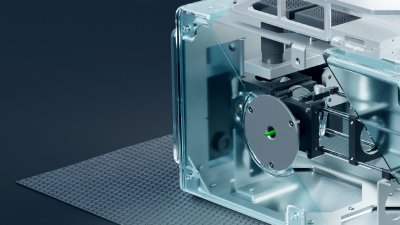
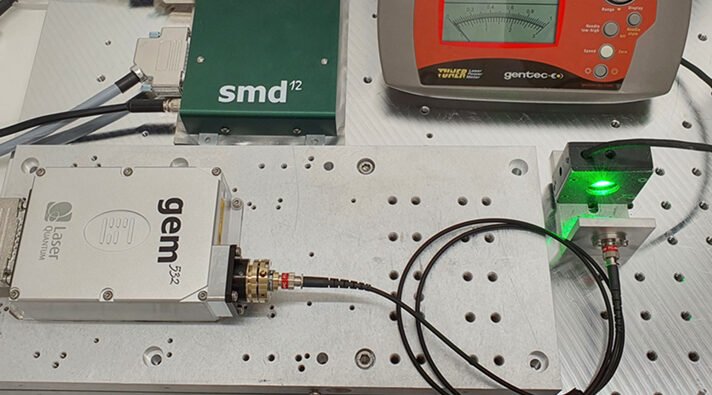
This technical paper from a five-author collaboration between Novanta and Schaefter+Kirchhoff (Hamburg) documents 80% coupling efficiency — close to the 85% theoretical ceiling — across Novanta’s gem and opus DPSS lasers (473-1064 nm), with 2.4 W output from 3 W input at 532 nm and mechanical stability proven through 4.9 g RMS vibration and 45-hour continuous operation.
Key takeaways include:
- Why single-mode fibre coupling at high power has historically been so hard — most applications settle for multimode
- How the Novanta + Schaefter+Kirchhoff system reaches 80% efficiency, 5 points below the 85% theoretical ceiling
- When SM fibre coupling becomes essential: super-resolution microscopy, quantum sensing, NV-centre work, beam-pointing-sensitive applications
- What the system delivers across stress: >75% efficiency through 16°C swing, no degradation after 4.9 g RMS vibration
- A practical wavelength menu: 473, 532, 561, 640, 660, 671, 1064 nm with guaranteed >70% coupling
Download the full technical paper for the coupling-efficiency vs temperature curves, the vibration and long-term stability test results, and the wavelength availability matrix across Novanta’s gem and opus DPSS laser families — before specifying a multimode fibre and accepting the beam-quality loss your microscopy or quantum-sensing application can’t afford.