




Technical Paper Overview
Optimizing Energy Density for Deep Engraving
Fluence, not average power, decides deep engraving quality and removal rate.
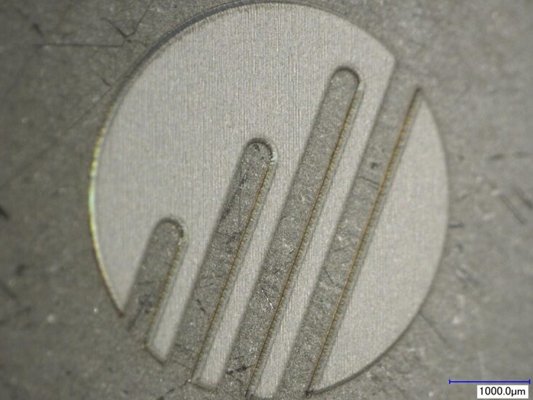
Deep engraving for jewelry and watches lives in a narrow process window: ~5 mm³/min removal rate, surface roughness under 2 µm, sharp 50 µm feature corners, no burr, and a 1-5 µm microstructure fine enough to reflect light into a specific color — without post-processing. Hitting all four targets simultaneously isn’t a power problem. It’s a fluence problem.
This technical paper from three Novanta authors documents systematic deep-engraving tests on stainless steel using a 40W 8ps picosecond laser, a Squirrel 11mm 2D scan head, and an 80mm F-theta lens — varying laser repetition rate (200kHz vs 1MHz), power (50% vs 100%), and burst mode (1-10 pulses) to map fluence against removal rate and surface roughness.
Key takeaways include:
- Why deep engraving is quality-limited, not power-limited — higher average power doesn’t improve results unless scan speed scales
- How fluence (energy density per pulse) maps to removal rate and surface roughness — and where the curves invert
- When 200kHz operation beats 1MHz: deep engraving where high pulse overlap at 1MHz creates 30 µm burr artifacts
- What burst-mode operation does: split pulse energy across 2/5/10 sub-pulses to fine-tune fluence below single-pulse limits
- A practical optimal recipe documented: 0.6 J/cm² at 200kHz, ~18W, 10 burst pulses → smooth steel engraving with color finish
Download the full technical paper for the removal-rate vs. fluence curves across both repetition rates, the surface-roughness maps from 1.5 µm to 30 µm extremes, and the documented optimal recipe for steel deep-engraving in jewelry and watch applications — before defaulting to maximum laser power and ending up with burnt-edge artifacts.