







By Francesc Marlasca, Business Development Manager
When we attended the Humanoids Robot Summit in Stuttgart, Germany this year, we did not expect how much the industry has evolved.
A few years ago, discussions centered on whether humanoid robots could actually work. Robot developers and original equipment manufacturers (OEMS) were proving that robots could walk, manipulate objects, maintain balance and perform increasingly complex tasks.
Today, that debate is largely over.
The focus has shifted to a more practical challenge: How do we deploy humanoid robots safely and at scale?
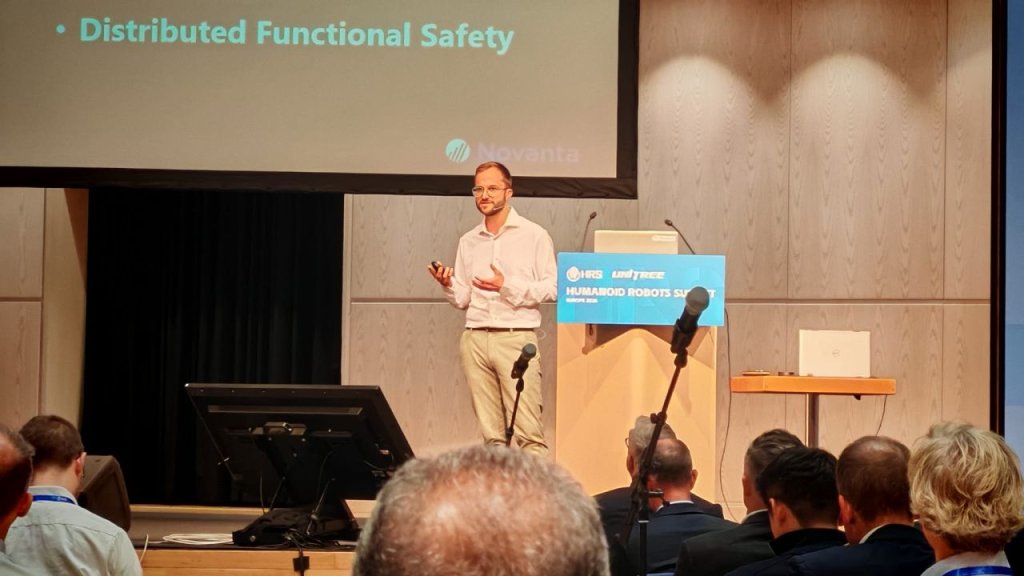
What struck me throughout the event was that success will require much more than advances in robotics hardware. It will depend on evolving safety architectures, emerging standards, manufacturing readiness and collaboration across the broader robotics ecosystem. The industry is increasingly focused on implementation rather than demonstration.
Safety Is Becoming the Industry’s Defining Challenge
One of the strongest themes throughout the summit was safety.
As humanoid robots move into environments shared with people, the industry faces challenges that extend beyond traditional industrial automation. Many humanoid robots weigh more than 100 kilograms, raising important questions about how they can operate safely and effectively alongside human workers.
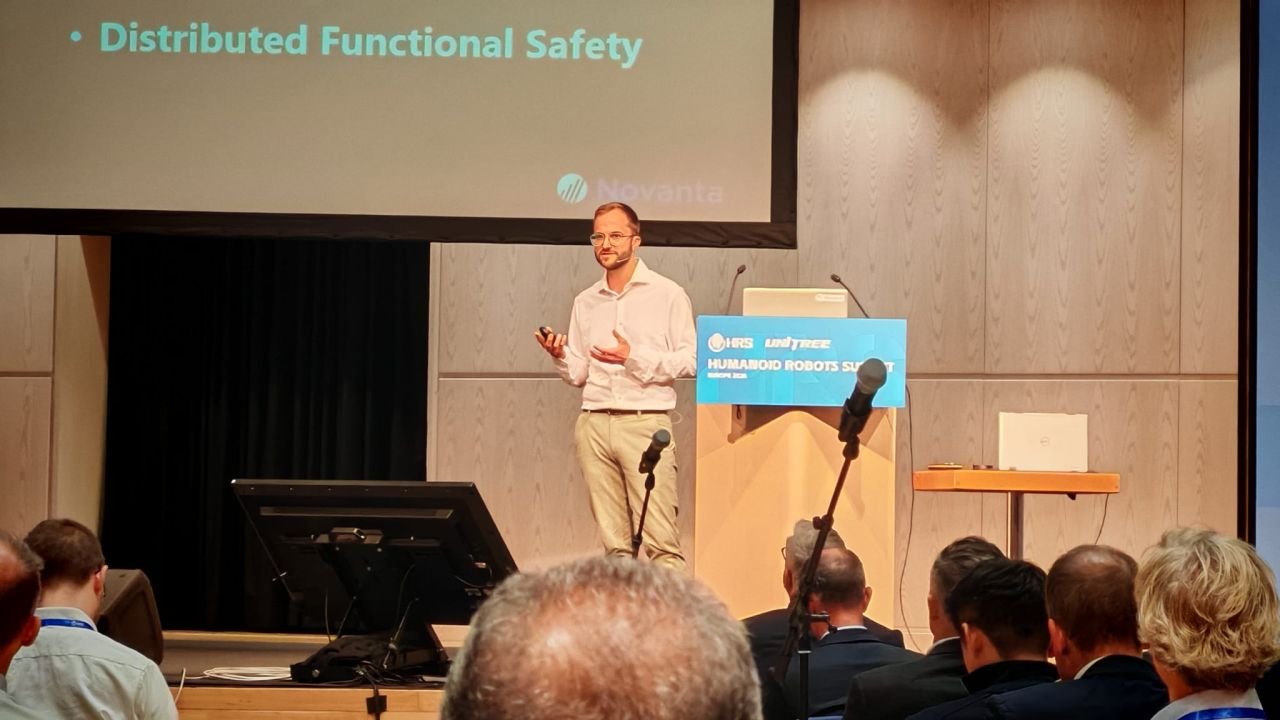
One of the most insightful presentations on this topic came from our own team member, Ricard Picas Prat, PhD, our Advanced Solution Engineer, whose keynote presentation, Functional Safety for Humanoid Actuators, explored how safety concepts are evolving to address the unique demands of humanoid motion systems.
Traditionally, safety systems have focused on stopping a machine when a risk is detected. Ricard explained that humanoid robots require a different approach. Because they continuously balance and adapt to their surroundings, simply stopping motion may not always be the safest response.
His presentation examined how the industry is moving beyond traditional stop-based safety functions and toward approaches that help robots maintain control and stability while operating safely.
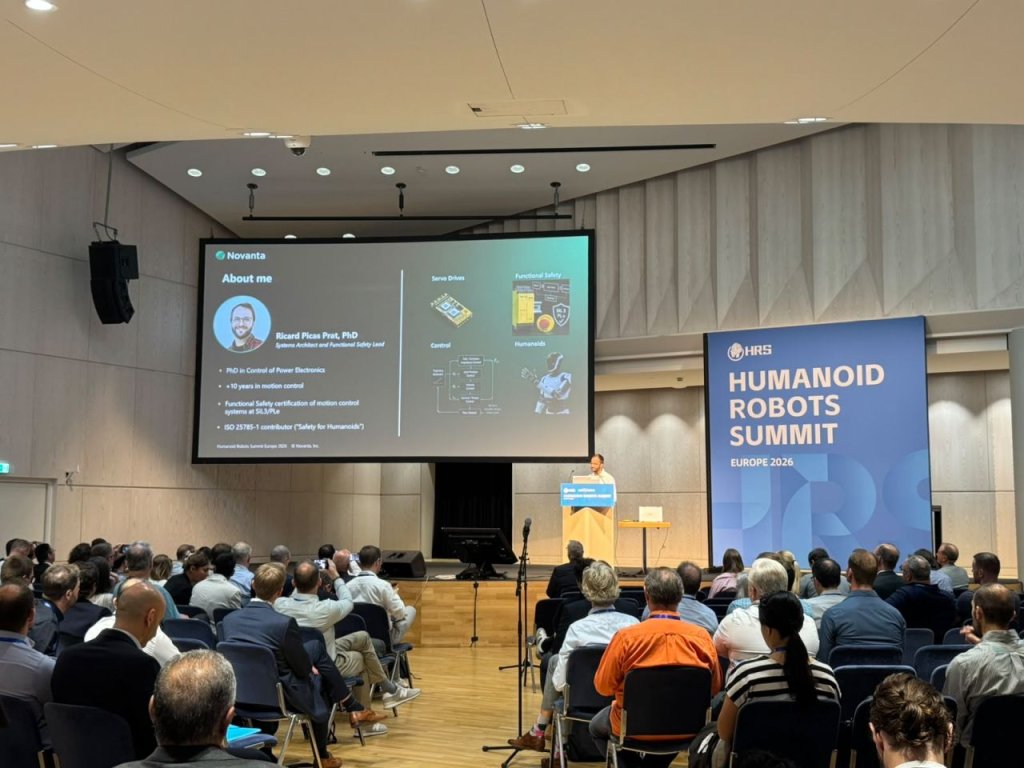
What I found particularly compelling was the idea that future safety systems may be defined less by how quickly a robot stops and more by how intelligently it responds when a hazardous event is detected.
Another takeaway that surfaced repeatedly throughout the summit was that functional safety is rapidly becoming a prerequisite for deployment rather than a differentiating feature. As adoption accelerates, customers increasingly view safety as a foundational requirement.
This is an area where our company is well positioned to contribute through both standards development and technologies designed to support safer human-robot collaboration.
Why Advanced Sensing Matters
Force-torque sensing was another topic that generated significant interest.
Humans instinctively know when they have grasped an object and how much force they are applying. Robots need sensing technologies to gain that same awareness.
Force-torque sensors provide the feedback needed to detect contact, measure applied force and confirm successful task completion. As humanoid robots take on more sophisticated responsibilities, that information becomes critical to both precision and safety.
The conversations we had throughout the summit reinforced how important sensing will be as developers create robots capable of interacting more naturally with people and their surroundings.
The Market Is Maturing
The growing presence of automotive suppliers, industrial manufacturers and other technology companies reflected the increasing momentum behind humanoid robotics.
Many organizations view the market as a potential long-term growth opportunity and are exploring how their expertise can contribute to its development.
At the same time, customers are becoming more focused on scalability. The discussion is no longer limited to performance and innovation. Companies want to know whether suppliers and partners can support production as programs move from prototypes to large-scale deployment.
In a market evolving this quickly, success increasingly depends on anticipating future requirements and developing solutions before they become mainstream expectations.
Looking Ahead
What excites me most is that the conversation has moved beyond possibility.
The question is no longer whether humanoid robots will become part of industrial environments. The focus is now on how quickly, safely and effectively they can be deployed.
Achieving that vision will require advances in physical AI sensing, actuation and manufacturing, along with new approaches to functional safety.
Based on the discussions at the Humanoid Robots Summit, the industry is already moving in that direction.
For our company, this creates an opportunity to help shape what comes next through advanced motion technologies, precision sensing and functional safety expertise.
The future of humanoid robotics is still being written, but one thing is already clear: The industry is moving toward adoption faster than ever before.