




Technical Paper Overview
Challenges of CO₂ Laser and Scan Head Subsystem Integration
Subsystem performance, not component spec, decides production-floor results.
A CO₂ laser is selected for pulse performance, output power, and wavelength. A scan head is selected for field size, spot size, speed, and accuracy. Each component spec’d in isolation. But the production-floor result depends on how those two behave together — on optical-beam matching, mechanical alignment, and electrical integration that no individual datasheet describes.
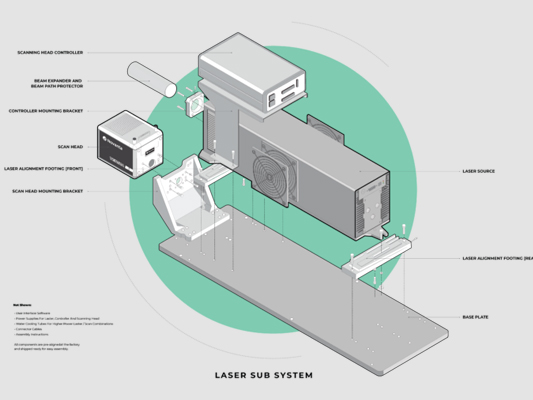
This technical paper from three Novanta authors (Daniel Schue, Justin Conroy, Malte Hemmerich) documents the integration problem: why a 1.5× ratio between scan-head clear aperture and laser 1/e² beam diameter is the sweet spot, why fiber delivery breaks down above 30 W CO₂, and how Novanta’s pre-aligned Synrad baseplates with wedge-based or shim-based mounting feet replace the traditional gold-standard 2-mirror alignment process.
Key takeaways include:
- Why subsystem performance is a separate engineering problem from component selection — and what datasheets miss
- How a 1.5× ratio between scan-head clear aperture and laser 1/e² beam diameter delivers 99% energy without diffraction rings
- When fiber delivery breaks down for CO₂: above ~30 W of laser power, free-space optics become mandatory
- What Novanta’s pre-aligned subsystem approach replaces: the traditional 2-mirror, 2-target alignment process
- A practical mounting-foot decision: shim-based (discrete) vs. wedge-based (continuous, more precise)
Download the full technical paper for the Gaussian aperture-matching math, the phosphorus-screen alignment technique, and the shim vs. wedge mounting-foot comparison — plus the Novanta subsystem architecture (laser + scan head + ScanMaster Controller).