



Technical Paper Overview
Single-Molecule Localization Microscopy: Beyond the Abbe Diffraction Limit
Wavelength precision and beam quality, not diode power, decide SMLM resolution.
For decades, the Abbe diffraction limit capped optical microscopy at 200-300 nm lateral resolution — a barrier that meant cell biologists could see the gross architecture of cellular machinery but not the molecular interactions inside it. The 2014 Nobel Prize in Chemistry recognized the techniques that broke through that barrier, including Single-Molecule Localization Microscopy.
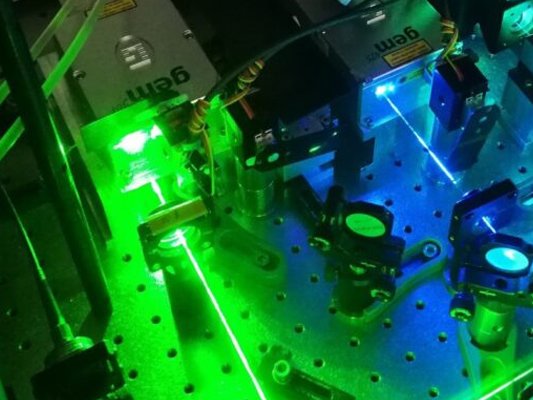
This technical paper from Laser Quantum (a Novanta brand) walks through the SMLM technique pioneered by Eric Betzig — including how random photoactivation, single-emitter detection, and centroid localization compress lateral resolution from 300 nm down to 5 nm — and details the specific laser requirements (~500 mW at 405, 473, 561, and 640 nm) that diode lasers struggle to meet.
Key takeaways include:
- Why the Abbe diffraction limit caps conventional fluorescence imaging at 200-300 nm lateral resolution
- How SMLM uses random photoactivation + single-emitter centroid localization to achieve 5 nm resolution — a 60× improvement
- When PALM-style techniques apply: paFPs in the GFP family, with paired 405 nm and 561 nm illumination
- What laser specs SMLM actually requires: ~500 mW, multiple wavelengths (405, 473, 561, 640 nm), near-perfect beam quality
- A practical reason to source multiple SMLM wavelengths from one supplier: matched performance, single integration, beam-shaping headroom
Download the full technical paper for the SMLM technique explained from Abbe through 2014 Nobel work, specific wavelength and power requirements for paFP-based imaging, and Laser Quantum’s gem laser spec set — before specifying an illumination source that won’t reach the 5 nm resolution your experiment needs.