

Technical Paper Overview
Unlocking Electric Motor Efficiency with Laser Hairpin Stripping
Two-step laser stripping, not single-laser ablation, decides hairpin weld quality.
Hairpin stators are how high-efficiency electric motors get their efficiency. Rectangular copper wires with thicker copper fill factor than traditional round wire, organic insulation for safety. But the assembly hinges on welding the hairpin ends together — and a single micron of insulation residue on the copper produces weak welds, reduced motor efficiency, and inconsistent production yield.
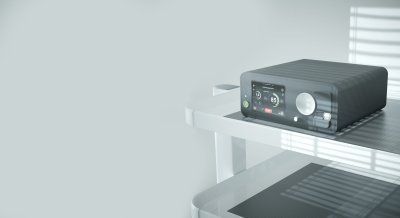
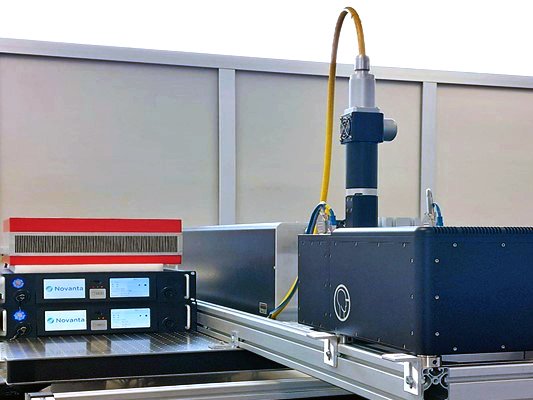
This technical paper from three Novanta authors documents a two-step laser process for hairpin stators: a 400W CO₂ laser (Novanta Firestar i401 at 10.6 µm) removes the bulk insulation, then a 200W nanosecond fiber laser removes the residual 1-2 µm layer — both running simultaneously through Novanta’s Chameleon dual-wavelength 3-axis scan head, achieving <1.0 second cycle times.
Key takeaways include:
- Why hairpin weld quality — and therefore motor efficiency — depends on complete removal of organic insulation (microns of residue fail the weld)
- How a two-laser combo (CO₂ for bulk + fiber for residue) outperforms any single-laser approach on speed AND quality
- When to choose 9.3 µm CO₂ over 10.6 µm: depends on insulation chemistry (PA, PE, PI), measured via ATR IR spectrometer
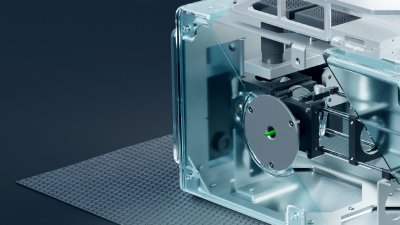
- What the Chameleon scan head enables: dual-wavelength processing through one 3-axis head with 75% field overlap
- A practical industry benchmark: <9 RFU fluorescence achieved on four hairpin designs in <1.0 second cycle
Download the full technical paper for the ATR IR-spectrometer absorbance data across four insulation materials, the parameter sets for the CO₂ + fiber two-step process, and the Chameleon dual-wavelength scan-head architecture — before specifying a single-laser stripping system that doubles your cycle time and machine footprint.