






Key Takeaways
- Dual-comb spectroscopy (DCS) uses two optical frequency combs with slightly different repetition rates to measure a sample’s spectral response.
- Interfering the two combs maps optical frequencies into the radio-frequency (RF) domain, where standard electronics can read them.
- DCS delivers fast, broadband, high-resolution measurements with high signal-to-noise ratio and no moving parts or gratings.
- Its simple architecture suits fiber and chip-based designs, making dual-comb spectrometers compact and robust.
- High repetition-rate femtosecond lasers make strong comb sources, because wider tooth spacing puts more power in each comb line.
Dual-Comb Spectroscopy: Speed Meets Precision
Dual-comb spectroscopy, often abbreviated DCS, is an advanced spectroscopic technique. It uses two coherent laser sources whose spectra consist of discrete, equally spaced frequency lines. A laser source with this type of spectrum is called a frequency comb.
The primary benefit of using two frequency combs is that a sample’s spectral response can be measured quickly on what is known as a tooth-by-tooth basis, with each comb line acting as its own precise measurement channel. But what does this mean in practice? It is worth looking at how dual-comb spectroscopy works to understand its benefits.
Dual-Comb Spectroscopy: The Basics
In dual-comb spectroscopy, an RF spectrum is generated by heterodyning two frequency combs with slightly different repetition rates. The resulting RF comb consists of distinguishable beat notes between pairs of optical comb teeth.
In practice, the sample is placed in the beam path of one or both combs, and its spectral response is recovered through heterodyne detection. A fast photodiode combines both beams and produces a characteristic RF comb that standard electronics can read.
Because the optical and RF spectra correspond one-to-one, the RF comb can be sampled to produce a digital spectrum containing all the relevant spectroscopic data.
Dual-Comb Spectroscopy: The Benefits
Different configurations yield different information, but dual-comb spectroscopy is known for its speed, precision, and stability. It delivers rapid, broadband spectral measurements with high resolution and high signal-to-noise ratio. Performing spectral analysis in the RF domain also makes the measurement straightforward, and that simplicity extends to the overall architecture.
Unlike conventional spectrometers, dual-comb spectroscopy needs no moving parts or diffraction gratings to separate optical frequencies; that separation happens digitally in the RF domain.
As a result, both optical paths can be built on optical fibers or photonic chips, significantly reducing design complexity. Dual-comb spectrometers can therefore be small and robust, with good resilience to external disturbances.
Where Dual-Comb Spectroscopy Is Used
These strengths make DCS attractive wherever fast, precise, broadband measurement matters, including gas sensing and atmospheric monitoring, molecular spectroscopy in research labs, real-time monitoring of combustion and chemical reactions, and precision metrology.
Laser Sources for Dual-Comb Spectroscopy
The comb source sets the performance ceiling for any dual-comb system. Repetition rate determines comb tooth spacing, and a higher repetition rate spreads the laser’s power over fewer, more widely spaced lines, so each tooth carries more power and is easier to resolve.
How Novanta Can Help With Dual-Comb Spectroscopy
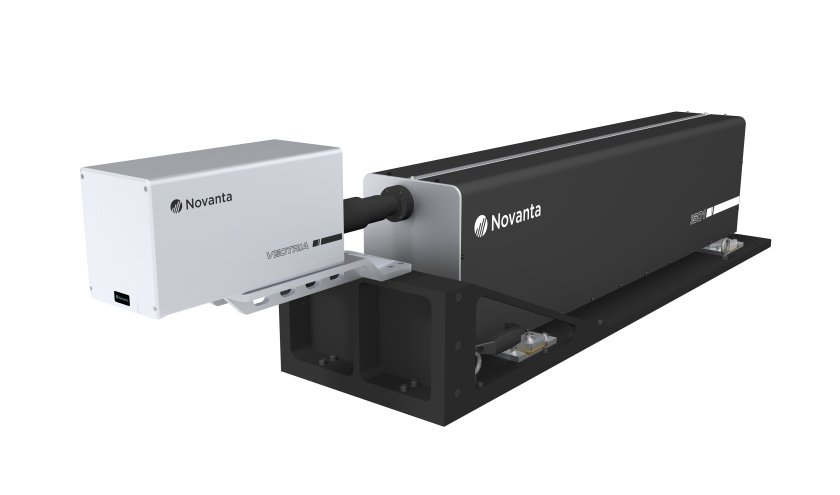
Product spotlight: taccor GHz femtosecond lasers. The taccor family is built for frequency comb generation. Its 1 GHz repetition rate gives roughly 10x greater mode separation and 100x more power per comb mode than a conventional ~100 MHz system, and the taccor X10 reaches 10 GHz with more than 1 W in pulses as short as 50 fs. Each is a turnkey Ti:sapphire mono-block that starts electronically. Explore our scientific research laser systems.
Building a dual-comb or frequency comb system? Talk to a Novanta application engineer or request a quote.